
Are you living in Ahmedabad and confused about choosing between RO, UV, or UF water purifier systems? Don’t worry — this guide will help you understand the difference between these water purification technologies and which one is suitable for your home.
In Ahmedabad, different types of water supply are available such as borewell water, municipal corporation water, Narmada water, and in some areas even mixed water supply (borewell + Narmada).
Water quality can vary from area to area. For example, in Chandkheda, most homes earlier used borewell water, but now some areas receive mixed supply from Narmada and borewell water.
Therefore, the first step before purchasing a water purifier is to understand your water source. Once you know your water supply type, it becomes easier to choose the right water purifier.
After reading this article, you will clearly understand which water purifier technology is best for your needs.
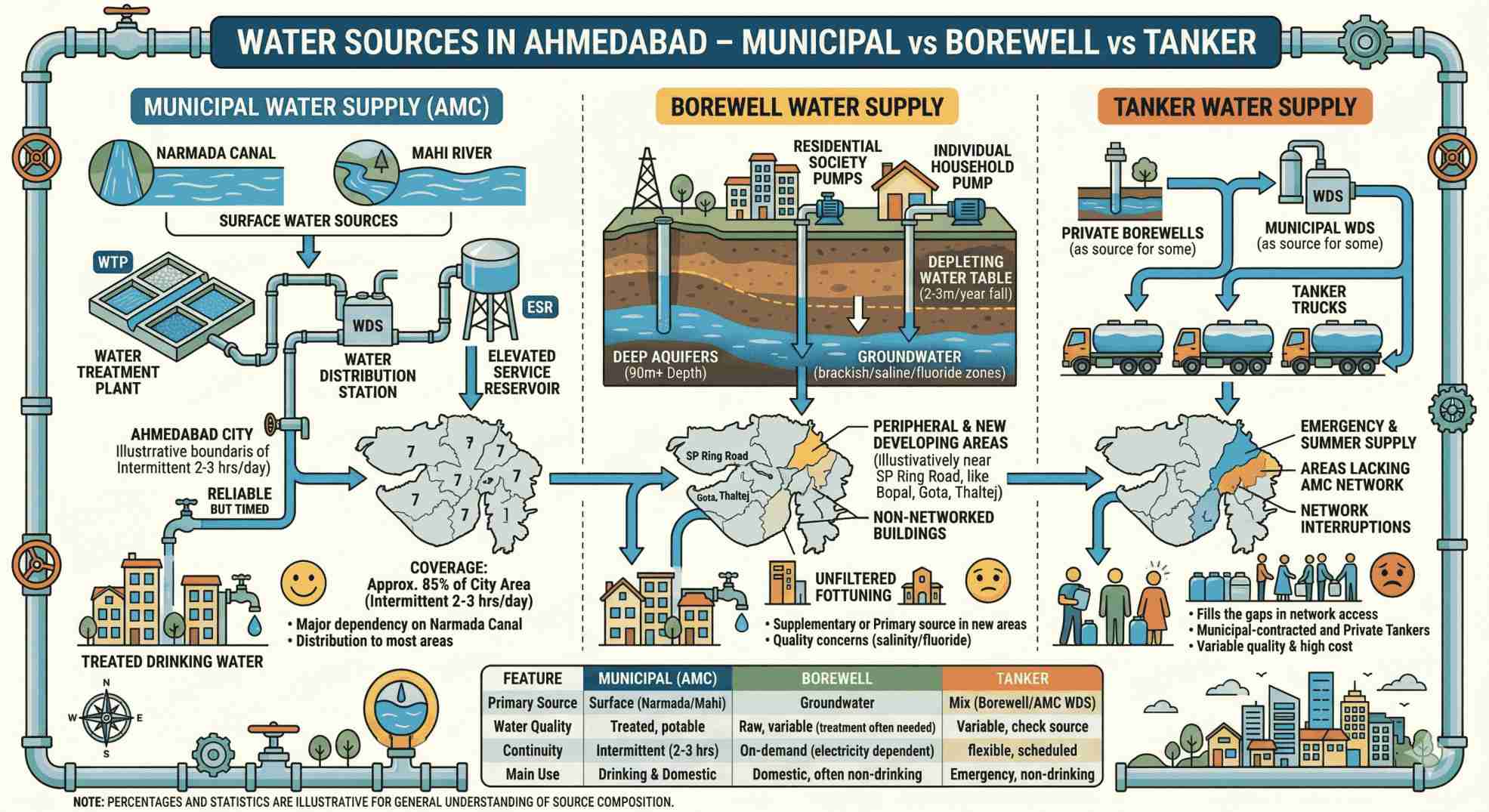
Common Water Problems in Ahmedabad
As discussed earlier about Chandkheda’s water supply, similar situations exist in many other areas of Ahmedabad where high TDS water is common.
High TDS water contains excess salts, heavy metals, and dissolved impurities, which may be harmful to your health if consumed for a long time.
Common water problems in Ahmedabad include:
- High TDS levels in borewell water
- Chlorine taste in municipal water
- Bacteria and microorganisms in stored water
- Sediments and suspended particles
- Possible heavy metal contamination in industrial areas
Because of these water contaminants, you should not take risks with your family’s health. It is important to choose the right water purifier technology according to your water supply.
Several purification technologies are available in the market, but the most commonly used are:
- RO (Reverse Osmosis)
- UV (Ultraviolet)
- UF (Ultrafiltration)
Let’s understand each purification technology one by one.
RO Water Purifier
RO (Reverse Osmosis) is one of the most advanced and widely used water purification technologies.
If your home or office receives borewell water, an RO water purifier is highly recommended. RO helps reduce the TDS level and removes harmful contaminants from water.
RO purification helps remove:
- Excess salts
- Heavy metals (lead, arsenic)
- Dissolved chemicals
- Pesticides
- High TDS levels
In many areas of Ahmedabad such as Chandkheda, Bopal, Gota, Sola, and Nikol, water often contains high TDS. In such cases, RO water purifiers are the best option.
However, the ideal drinking water TDS level should be between 50–300 ppm.
Sometimes, when using an RO system, the TDS level may drop below 50 ppm, which is not ideal for drinking water. In such cases, it is recommended to use an RO purifier with a TDS controller or mineral cartridge to balance the TDS level.
UV Water Purifier
UV purification uses ultraviolet light technology to disinfect water.
When water passes through a UV lamp, the ultraviolet light kills bacteria, viruses, and harmful microorganisms.
UV purification is effective for:
- Killing bacteria
- Destroying viruses
- Eliminating harmful microorganisms
However, UV purifiers do not remove dissolved salts or TDS.
Therefore, UV water purifiers are best used in areas where the water source is Narmada or municipal corporation water, where the TDS level is usually below 300 ppm.
You can also combine UV with RO systems, such as RO + UV purifiers, for additional protection.
UF Water Purifier
UF stands for Ultrafiltration.
The UF membrane works similarly to an RO membrane, but the key difference is that UF does not remove TDS.
UF membranes have very small pores (around 0.01 micron) that filter impurities from water.
UF membranes help remove:
- Dirt and sediments
- Suspended particles
- Bacteria and microorganisms
UF purification is best suitable for municipal or Narmada water supply in Ahmedabad, where TDS levels are already low.
UF mainly helps remove physical impurities and microorganisms.
In many RO systems, UF filters are also used as additional filtration stages
RO vs UV vs UF – Key Differences
| Feature | RO | UV | UF |
| Removes TDS | Yes | No | No |
| Removes heavy metals | Yes | No | No |
| Removes bacteria & viruses | Yes | Yes | Yes |
| Works for high TDS water | Yes | No | No |
| Requires electricity | Yes | Yes | No |
How to Choose the Right Water Purifier for Your Home
Before purchasing a water purifier, consider the following points:
1. Check Your Water Source
Identify your water source:
- Borewell water
- Municipal water
- Tanker water
- Mixed water supply
2. Check the TDS Level
Use a TDS meter to measure the TDS level of your water.
General guidelines:
| Purification Technology | When To use | Good to Use | TDS Level |
| RO | Borewell water / Mixed water | Mineral filter, Alkaline filter, B12 filter | Above 300 ppm |
| UV | Municipal / Narmada water | Sediment filter, Carbon filter | Below 300 ppm |
| UF | Municipal / Narmada water | Sediment filter | Below 300 ppm |
| RO + Tds Controller | Any water source | Alkaline + B12 | 50 – 500 ppm adjustable |
3. Choose Suitable Storage Capacity
Select storage capacity based on family size:
- Small family – 7–8 liters
- Medium family – 10–12 liters
- Large family – 12+ liters
4. Service and Maintenance
Always choose a water purifier brand that provides reliable service support in Ahmedabad and easy filter replacement.
Conclusion
Now you should have a clear understanding of the differences between RO, UV, and UF water purifiers.
RO Water Purifier:
Best for borewell water or water with TDS above 300 ppm. If the TDS is lower than 300 ppm, you can still use RO with a TDS controller or mineral cartridge.
UV Water Purifier:
Best for low TDS municipal water where the main concern is bacteria and viruses.
UF Water Purifier:
Also suitable for low TDS water, mainly for removing dirt and suspended particles.
After choosing the purification technology according to TDS level and water source, you can select additional features such as storage capacity, mineral filters, or alkaline filters based on your needs.


