RO Water Purifier Installation in Ahmedabad – Complete Guide
In Ahmedabad, clean and safe drinking water is essential for every family. However, water quality can vary significantly from one area of Ahmedabad to another. Some households receive municipal water, while others depend on borewell water, Narmada water or a mix of water from the different water sources.
So because of the different water supply it’s important to choose a right water purifier for your family specifically in ahmedabad location.
If you are planning to purchase a new RO water purifier or looking for professional RO water purifier installation in Ahmedabad, understanding the complete installation process helps you to choose the right water purifier for your home. I am sure When you complete reading of this blog you will get a complete idea about the RO installation.
In this complete guide, we will explain everything you need to know about RO installation, including water quality testing, installation requirements, ideal placement, installation steps, costs, maintenance and common mistakes to avoid.
Whether you live in Chandkheda, Motera, Gota, Bopal, South Bopal, Nikol, Naroda, Maninagar or any other part of Ahmedabad, this guide will help you understand how to get your water purifier installed correctly.
Why Is Proper RO Water Purifier Installation Important?
When you purchase a water purifier for your home, proper installation is just as important as choosing the right purifier. Several factors need to be considered during installation to ensure that the system operates efficiently and delivers safe, purified drinking water.
Incorrect installation can lead to several problems, including:
- Water Leakage: Poorly fitted pipe connections can cause water leakage.
- Improper Drainage: Incorrect drain connections can prevent rejected water from draining properly.
- Low Water Flow: Improper installation may affect the water flow from the purifier.
- Loose Inlet Connections: Incorrect or loose inlet connections can interrupt the water supply.
- Excessive Pressure: Incorrect water pressure can put unnecessary stress on the RO system.
- Storage Tank Problems: Improper tank connections may affect water storage and dispensing.
- Unsuitable Water Pressure: Low or excessively high inlet pressure can reduce the purifier’s performance.
- Initial Filter Flushing: New filters should be properly flushed before the first use to remove dust, carbon particles, and manufacturing residues. This helps ensure better filtration performance and protects the RO system.
Professional RO water purifier installation helps prevent these issues, improves system efficiency, and ensures reliable performance over the long term.
Understanding Ahmedabad’s Water Quality Before Installing an RO
Before installing an RO water purifier, it is important to understand the quality of your local water supply. Ahmedabad receives water from different sources, including borewells, municipal corporation supply, Narmada water, and mixed water sources.
Each water source has different characteristics, mineral levels, and potential contaminants. Understanding these differences will help you choose the right water purifier for your home.
Let’s understand the major water sources in Ahmedabad and which type of water purifier may be suitable for each.
1. Borewell Water (Often High in TDS and Hardness)
Many residential areas in Ahmedabad rely on borewell water for their daily household requirements.
Borewell water can contain higher concentrations of dissolved minerals and salts, depending on the geographical location and local groundwater conditions. In some areas, borewell water may have TDS levels above 300 PPM, while certain locations may experience significantly higher levels.
Some common concerns associated with borewell water include:
- High Total Dissolved Solids (TDS).
- Water hardness due to dissolved calcium and magnesium.
- Unpleasant taste due to excess dissolved minerals.
- Possible contamination from local groundwater conditions.
- Potential presence of other unwanted substances, depending on the groundwater source.
Which water purifier is suitable for borewell water?
An RO water purifier is generally a suitable choice when water testing indicates elevated TDS or other dissolved contaminants that require RO treatment.
For better results, consider an RO water purifier with a TDS controller, along with additional filtration stages if required based on your water quality.
2. Narmada Water (Treated Municipal Water)
Ahmedabad receives a significant portion of its municipal water supply through the Narmada water system, which is connected to the Sardar Sarovar Project.
Water is transported through an extensive canal network across Gujarat and supplied to municipal water treatment facilities. Before reaching households, this water undergoes treatment to reduce impurities and make it suitable for municipal distribution.
Some important water treatment facilities associated with Ahmedabad’s water supply include:
- Kotarpur Water Treatment Plant
- Jaspur Water Treatment Plant
- Raska Water Treatment Plant
Depending on the municipal distribution network, areas such as Chandkheda, Motera, Sabarmati, Ranip, and other parts of Ahmedabad may receive treated municipal water originating from the Narmada system.
What makes Narmada water a good option for households?
Compared with groundwater from many borewell sources, treated Narmada water generally has lower dissolved mineral levels. However, actual TDS levels can vary depending on the source, treatment process, and distribution conditions.
If your household receives Narmada water with relatively low TDS, you may consider different water purification options.
For example:
- RO Water Purifier with TDS Controller: Suitable when additional dissolved contaminant reduction is required.
- Alkaline Water Purifier: An option for people who prefer additional mineral-related filtration features.
- Copper and Zinc Filters: Optional additional filtration stages depending on your preferences.
One important advantage of relatively low-TDS municipal water is that RO membranes may experience less scaling compared with certain high-hardness borewell water sources. This can help reduce maintenance requirements, depending on the actual water quality and usage.
3. Municipal Corporation Water (AMC Water Supply)
Many residential areas in Ahmedabad receive treated water through the Ahmedabad Municipal Corporation (AMC) water supply network.
Municipal water is treated before distribution to households. Water quality is monitored through parameters such as pH, residual chlorine, and other water quality indicators.
The TDS level of municipal water can vary depending on the source and distribution zone. In many locations, it may fall within approximately 140–250 PPM, although actual readings should always be confirmed through water testing.
Step-by-Step RO Water Purifier Installation Process
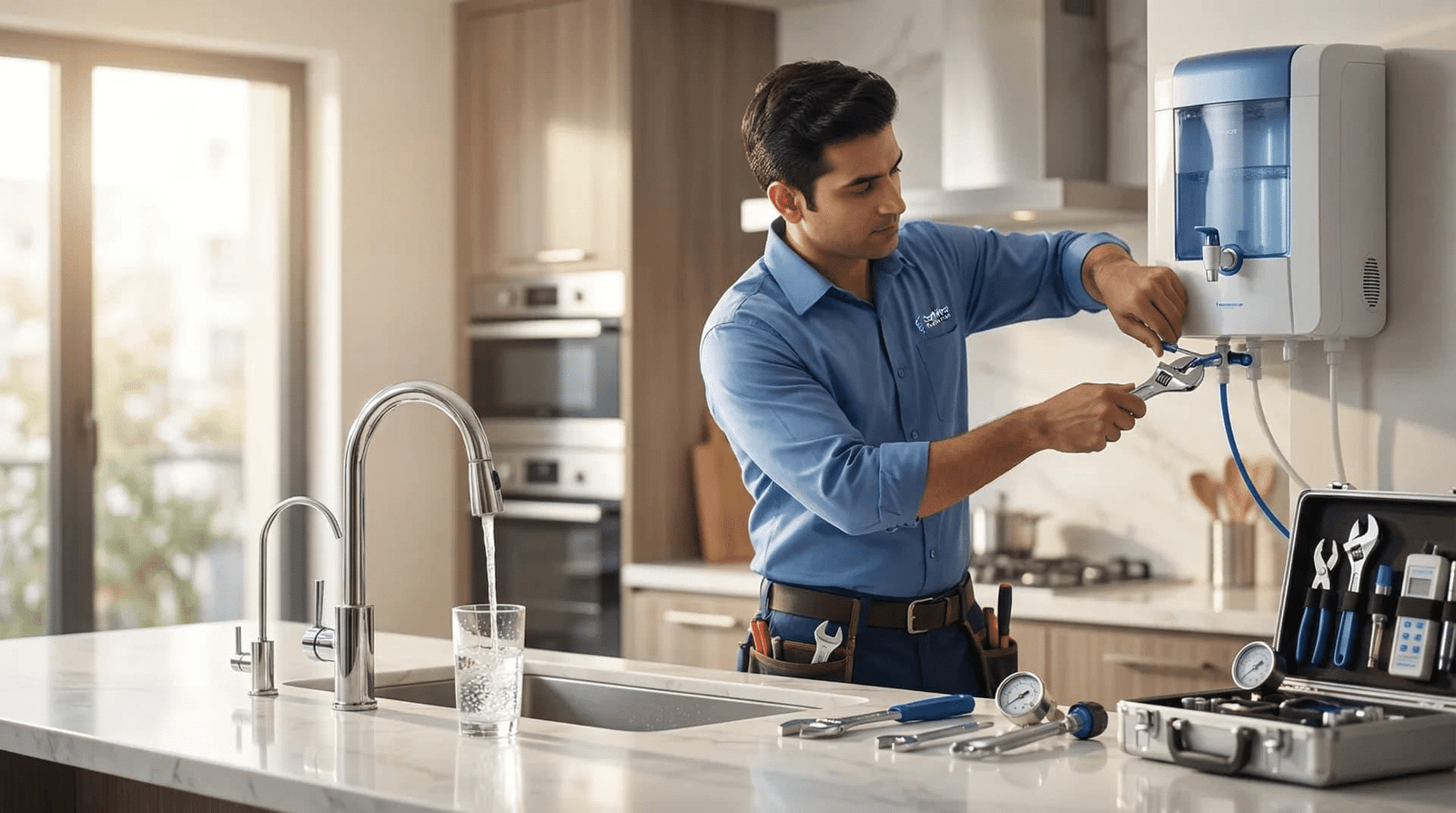
A professional RO installation generally involves several steps to ensure that the purifier is properly connected and ready for use.
Step 1: Inspect the Water Supply
The technician first checks the incoming water connection.
Important things to inspect include:
- Available water pressure.
- Water inlet pipe condition.
- Water source.
- Available space for installation.
- Accessibility of the water connection.
If the incoming water pressure is outside the purifier’s operating range, additional arrangements may be necessary.
Step 2: Select the Right Installation Location
Choosing the correct location is important for convenient operation and future servicing.
Ideally, your RO water purifier should be installed:
- Near the kitchen water supply.
- Close to a suitable drainage point.
- Near an electrical socket for electric RO models.
- Away from direct sunlight and excessive heat.
- In a location where filter replacement is convenient.
The wall should also be strong enough to support the purifier’s weight when its storage tank is full.
For an under-sink RO water purifier, sufficient cabinet space should be available for the purification unit, storage arrangement and maintenance access.
Step 3: Install the Water Inlet Connection
The technician connects the incoming water supply to the RO purifier using the appropriate inlet pipe and connector.
The connection should be secure to prevent water leakage.
An inlet valve is generally provided so that the water supply can be turned off during servicing or filter replacement.
Step 4: Connect the RO Drainage Pipe
RO water purifiers produce rejected water during the purification process.
This rejected water needs to be directed towards an appropriate drainage point.
The technician connects the reject-water outlet to a suitable drain arrangement.
Make sure that:
- The drainage pipe is not blocked.
- The pipe is properly secured.
- There are no unnecessary bends or restrictions.
- The rejected water does not leak inside the kitchen cabinet.
Where practical, rejected water can be collected for suitable non-drinking applications, such as floor cleaning, subject to its quality and local usage considerations.
Step 5: Connect the Electrical Supply
Electric RO water purifiers require a suitable electrical connection.
The technician checks the power connection and ensures that the purifier can operate safely.
Avoid using damaged electrical sockets or loose extension connections near water pipes.
Non-electric and non-storage water purifiers have different installation requirements and do not require the same electrical arrangements.
Step 6: Check the Storage Tank and Faucet
For RO purifiers with storage tanks, the technician checks the tank and its connections.
For under-sink models, a dedicated faucet is generally installed near the kitchen sink.
The faucet should be positioned conveniently so that family members can easily access purified drinking water.
Step 7: Flush the Filters and RO Membrane
Before using a newly installed RO purifier, the system should undergo the flushing process specified by the manufacturer.
This helps remove initial manufacturing residues and loose carbon particles from the new filtration components.
The technician should follow the manufacturer’s instructions regarding:
- Initial flushing.
- First tank filling.
- Water disposal.
- Filter preparation.
- Membrane flushing.
Do not start drinking water from a newly installed purifier until the required initial flushing and commissioning process is completed.
Step 8: Final Testing and Demonstration
After installation, the technician should check the complete system.
The final inspection generally includes:
- Checking all water connections.
- Checking for leakage.
- Verifying water flow.
- Checking drainage.
- Confirming storage tank operation.
- Checking the faucet.
- Testing the purified water quality where appropriate.
The technician should also explain basic operation, filter maintenance and service requirements.
Which Type of Water Purifier Should You Install in Ahmedabad?
In Ahmedabad, different types of RO water purifier systems are available, you can choose from according to different requirements like your home water supply, family requirements, RO space, and purification needs.
1. Ro System:
RO (Reverse Osmosis) technology uses a semipermeable membrane to reduce many dissolved substances present in water.
It is commonly considered for water containing elevated dissolved solids.
Suitable applications may include certain borewell water supplies and other sources where testing indicates a need for RO treatment. RO system usually installed where TDS level >300 PPM.
2. RO + UV water purifier
This combination uses RO purification along with ultraviolet treatment.
RO helps reduce dissolved substances, while UV treatment helps inactivate microorganisms when the system is correctly designed and maintained. So you can install RO + UV system to maintain tds level and virus.
3. RO + Alkaline Water Purifier
These systems combine RO purification with an additional alkaline or mineral-enhancement stage.
They are available for customers who prefer this type of water treatment configuration.
4. RO + Copper + Zinc Water Purifier
Some modern water purifiers include additional copper and zinc-related filtration or mineral-enhancement stages.
These are product-specific features. Their actual performance depends on the technology and specifications of the particular model.
5. Under-Sink RO Water Purifier
An under-sink water purifier is installed inside the kitchen cabinet, with a separate faucet above the sink.
It is a useful option for customers who prefer a clean kitchen countertop without a wall-mounted purifier.
Common RO Installation Mistakes You Should Avoid
Even a good water purifier can develop problems if installation is not carried out correctly.
Here are some common mistakes homeowners should avoid.
1. Installing Without Checking Water Quality
Buying an RO purifier without understanding your water quality may result in choosing an unsuitable purification system.
2. Choosing an Inaccessible Location
Installing the purifier in a difficult-to-reach area can make future maintenance and filter replacement inconvenient.
3. Incorrect Drainage Connection
A poorly connected reject-water pipe can cause leakage and drainage problems.
4. Ignoring Electrical Safety
Electric RO purifiers should have a safe and suitable electrical connection.
5. Not Flushing the New Filters
Initial flushing should never be skipped. Always follow the manufacturer’s instructions before drinking water from a newly installed purifier.
6. Ignoring Future Maintenance
RO membranes, filters and other components require maintenance according to their condition and the manufacturer’s recommendations.
Looking for RO Water Purifier Installation in Ahmedabad?
If you are planning to install a new RO water purifier in Ahmedabad at your home, choosing the right model and getting it installed correctly can make a significant difference.
We offer water purifier solutions for different household water requirements, including systems designed for borewell, Narmada and municipal water sources.
Whether you need a wall-mounted RO purifier or a modern under-sink water purifier, you can explore different options according to your requirements and budget.
Why Contact Us?
- Multiple RO water purifier models available.
- Options with RO, Alkaline, Copper, Zinc, UV and TDS Controller features.
- Different storage capacities.
- Assistance in selecting a suitable purifier.
- Home delivery in Ahmedabad.
- Installation assistance.
- Cash on Delivery facility.
- Online payment options.
Are you confused in choosing the best RO water purifier then you call on 7600938484 for solution in Ahmedabad.